
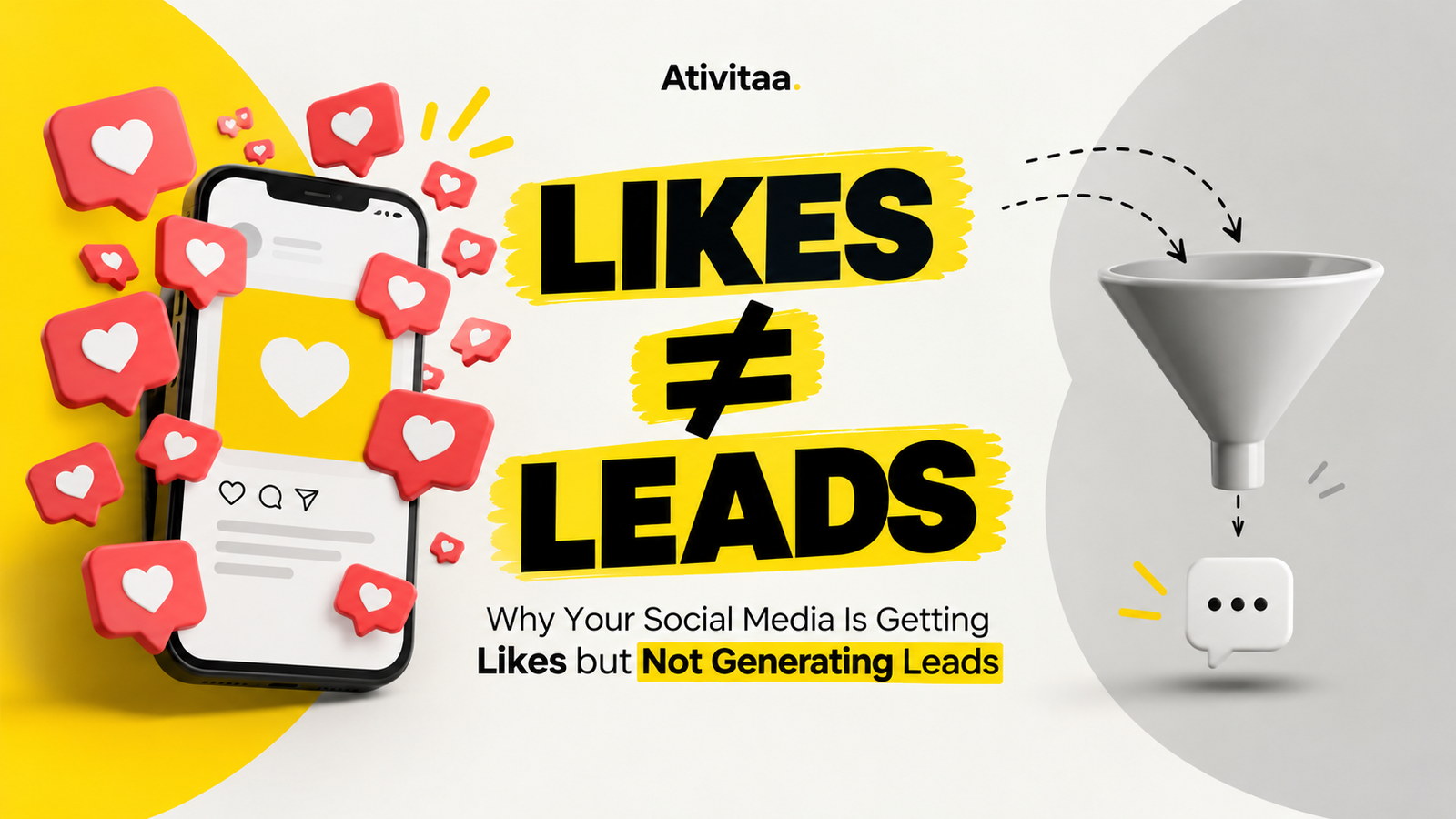
Why Your Social Media Is Getting Likes but Not Generating Leads
You post regularly. Your creatives look good. People like your posts, react to your reels and occasionally leave comments.
But there's one problem.
Your phone isn't ringing. Your inbox isn't filling up with enquiries. And your social media presence isn't bringing in the business you expected.
It's a familiar challenge for many businesses investing in social media marketing.
The problem isn't necessarily that your content is bad. It may be that your content is doing one job while your business expects it to do another.
Let's understand why this happens and how to build a more effective social media marketing strategy.
1. Likes and Leads Are Two Different Things
A like is a reaction. A lead is an expression of interest in your business.
Someone might like an Instagram post because it's funny, visually appealing or relatable. But that doesn't necessarily mean they're interested in purchasing your product or service.
Social media engagement metrics include likes, comments, shares, saves and views. These can indicate how audiences interact with your content.
Lead generation involves encouraging potential customers to take meaningful actions such as:
- Sending a WhatsApp enquiry
- Filling out a website contact form
- Calling your business
- Requesting a quotation
- Booking a consultation
- Registering interest in your service
A successful social media strategy should measure the actions that matter to your business, not just the numbers that look impressive.
2. You're Creating Content Without a Clear Objective
One of the most common social media marketing mistakes is posting simply because the calendar says it's time to post.
Monday needs a motivational quote. Wednesday needs a reel. Friday needs a trending post.
But what is each piece of content supposed to achieve?
Every post doesn't need to generate an immediate sale, but it should have a purpose.
For example, content can help you:
Build awareness: Introduce your business to people who haven't heard of you.
Establish credibility: Demonstrate expertise through useful information, case studies or customer experiences.
Create consideration: Explain how your products or services solve specific problems.
Encourage action: Invite interested customers to enquire, register, book or purchase.
A balanced social media marketing strategy connects these objectives instead of treating every post as an isolated creative.
3. Your Content Attracts Attention, but Not the Right Audience
Imagine a business that offers premium branding services.
One of its funny reels goes viral and attracts thousands of views. That sounds promising.
However, if most viewers are students enjoying the entertainment rather than business owners looking for branding services, those views may have limited commercial value.
This doesn't mean entertaining content has no place in marketing.
It means that reach becomes more valuable when it includes people who are relevant to your business.
Before planning content, identify:
- Who is your ideal customer?
- What challenges do they face?
- What influences their purchasing decisions?
- What questions do they ask before choosing a product or service?
- Which platforms are they using?
When your content speaks directly to your intended audience, it has a better chance of attracting meaningful interest.
4. You're Showing What You Sell, Not Why It Matters
Businesses often focus heavily on showcasing their products and services.
A design agency posts graphics. A restaurant posts food photographs. A real estate company posts property images.
There's nothing wrong with showcasing your work.
But customers frequently need more information before making a decision.
They want to understand what makes your offering relevant to their needs.
For example, instead of simply announcing that your company provides website development, explain how a poorly structured website can discourage potential customers from submitting enquiries.
Instead of only sharing attractive social media designs, demonstrate the thinking behind a campaign and the business objective it was created to support.
This approach shifts communication from describing what you offer to explaining why it matters.
5. Your Social Media Has No Clear Conversion Path
Suppose someone discovers your brand through Instagram and becomes genuinely interested.
What happens next?
Can they easily find your contact details? Is there a clear website link? Does your profile explain what your business offers? Is there an obvious way to request information?
If your potential customer has to search extensively to contact you, you may lose an opportunity.
A clear conversion path is essential.
Depending on your business, this could include:
- A WhatsApp enquiry button
- A dedicated landing page
- A contact or quotation request form
- A call button
- A product catalogue
- An online booking system
The conversion journey should feel simple and natural.
For service-based businesses, a strong landing page can be especially useful because it explains the offering, establishes credibility and gives visitors a clear next step.
This is why website development and landing page design should work alongside your social media strategy.
6. You're Expecting Organic Social Media to Do Everything
Organic content plays an important role in building familiarity, trust and ongoing audience engagement.
However, relying entirely on organic posting may limit how predictably you can reach specific potential customers.
This is where performance marketing and paid advertising can support your strategy.
Platforms such as Facebook and Instagram allow businesses to run campaigns with different objectives, including awareness, website traffic and lead generation.
The important part is selecting the right objective and building an appropriate campaign around it.
For example, a business seeking enquiries might use a lead form, a WhatsApp conversation or a dedicated landing page.
But paid advertising isn't automatically profitable.
Campaign success depends on factors such as audience relevance, creative messaging, the offer, budget, conversion experience and ongoing optimisation.
Advertising can increase exposure. A well-planned strategy helps make that exposure more meaningful.
7. Your Creative Looks Good but Doesn't Communicate Enough
Good design attracts attention.
Effective advertising creative should also help audiences understand the message.
Think about the last advertisement that genuinely interested you.
Was it simply beautiful, or did it communicate something relevant?
Strong social media creatives often combine three elements:
A clear hook: Something that catches attention quickly.
A relevant message: A reason for the intended audience to care.
A meaningful next step: An action that fits the audience's level of interest.
For instance, a business selling premium services might benefit from presenting a common customer challenge, explaining its approach and encouraging an initial discussion.
The objective isn't to turn every creative into an aggressive sales advertisement.
It's to ensure that creative execution and marketing purpose work together.
8. You're Not Measuring the Right Numbers
Social media reporting often focuses on followers, impressions, reach and engagement.
These metrics can provide useful information, but they don't always tell the complete business story.
If lead generation is your objective, also evaluate:
- Number of qualified enquiries
- Cost per lead from paid campaigns
- Landing page conversion rate
- WhatsApp conversations initiated
- Lead-to-customer conversion rate
- Cost per acquired customer, where measurable
Consider a hypothetical example.
Campaign A receives 50,000 impressions and generates 10 enquiries.
Campaign B receives 15,000 impressions and generates 30 enquiries.
Even though Campaign A reaches more people, Campaign B generates more enquiries.
However, the final evaluation should also consider lead quality, campaign cost and whether those enquiries eventually become customers.
A meaningful marketing report connects campaign activity with business objectives.
9. Build a Social Media Strategy That Supports Business Growth
Businesses don't necessarily need to post more frequently.
They need a better connection between their content, target audience and desired outcomes.
A practical approach begins with understanding the business.
What do you sell? Who needs it? Why should customers choose you? What action do you want them to take?
From there, build a strategy that connects brand communication, creative execution and the appropriate marketing channels.
At Ativitaa, we approach this through our Idea to Icon Method.
Discover: Understand the business, its audience and marketing objectives.
Define: Establish a focused communication and creative strategy.
Design: Develop relevant content, campaigns and digital assets.
Deliver & Grow: Launch approved work and, for ongoing marketing engagements, review results and identify opportunities for improvement.
The process recognises an important principle: creative output should be guided by a clear understanding of what the business is trying to achieve.
If you're exploring external marketing support, understanding how to choose the right creative agency in Kolkata is also an important part of developing an effective marketing partnership.
10. Stop Chasing Likes. Start Creating Meaningful Connections.
Social media is not simply a place to publish content.
It's an opportunity to introduce your brand, demonstrate value, build credibility and connect with potential customers.
Likes, comments and shares can all play a role in that journey.
But they shouldn't be confused with business results.
The real question isn't just, "How many people liked our post?"
It's also, "Are we reaching the right people, communicating something valuable and giving interested customers a reason to take the next step?"
When strategy, creativity and execution work together, social media can become a more purposeful part of your marketing efforts.
Looking for a More Effective Social Media Marketing Strategy?
Ativitaa is a creative and digital marketing agency based in Kolkata, offering social media creative services, brand communication, digital campaigns and performance marketing.
We work with businesses to develop relevant creative communication and marketing approaches aligned with their objectives.
If your social media is attracting attention but not generating the enquiries you're looking for, let's talk about what could work better for your business.
Explore our creative and digital marketing services or contact Ativitaa to discuss your business requirements.